Capital Expenditures Are Reshaping Commercial Banking Opportunity


Increased investment and capital expenditures tied to reshoring manufacturing and tech advancement are leading to growth opportunities for commercial bankers and lenders.
Key Takeaways
- Capital expenditures are a leading indicator of commercial banking opportunity. Major investments in manufacturing, data centers, infrastructure, and technology create demand for commercial loans, equipment finance, treasury services, and long-term banking relationships well before projects become operational.
- The best lending opportunities emerge early in the investment cycle. Companies begin evaluating financing options months before construction or equipment purchases begin, making early visibility into expansion plans a significant competitive advantage for commercial lenders.
- One capital project creates an ecosystem of financing opportunities. Large investments generate business not only for the primary borrower but also for contractors, suppliers, manufacturers, logistics firms, engineering companies, and other businesses that require banking and financing solutions throughout the project lifecycle.
- Relationship intelligence helps banks identify growth opportunities before competitors. Monitoring signals such as land acquisitions, executive hiring, M&A activity, and corporate expansion enables commercial bankers to engage decision-makers earlier and build relationships before financing discussions become public.
Capital expenditures rarely attract the same attention as interest rates, inflation reports, or quarterly earnings. Yet for commercial bankers, equipment finance providers, and corporate lenders, few economic indicators offer a clearer view of future business activity.
When companies commit to major investments in facilities, equipment, infrastructure, and technology, they initiate a chain of economic events that can extend for years. Those investments create financing needs, establish new banking relationships, generate demand for equipment leasing, and often stimulate growth across entire regional economies.
As policymakers and corporate leaders increasingly focus on domestic manufacturing, infrastructure development, and AI-related investment, capital expenditure, or CapEx, have become a critical lens through which commercial financial institutions can evaluate opportunity.
The Forces Driving a New Investment Cycle
The United States is entering a period of elevated industrial investment. Several factors are contributing to renewed corporate spending on physical assets.
Federal and state policymakers have emphasized domestic production and supply chain resilience, incentivizing capital investment with legislation such as the One Big Beautiful Bill Act (OBBBA). Recent changes to SBA lending limits open new financing opportunities for growth-stage businesses. Efforts to reshore manufacturing have gained momentum as companies seek greater control over production capacity and logistics networks while taking advantage of available tax incentives.
Provisions within the OBBBA incentivize and encourage ongoing investment in domestic manufacturing, including:
- Full depreciation of qualified production property
- 100% bonus depreciation on machinery and equipment
- Immediate expensing on domestic research & development
Technology trends are reinforcing those policy objectives. The rapid expansion of artificial intelligence has created demand for physical infrastructure. While AI is often discussed as a software-driven phenomenon, the underlying reality is far more tangible. Data centers require land, buildings, power generation, cooling systems, networking equipment, and ongoing facility investment.
Across sectors, companies are announcing new facilities, production expansions, and infrastructure projects. Those announcements often receive significant media attention, but they represent only the beginning of a much longer process.
Understanding the CapEx Investment Life Cycle
Public announcements frequently create the impression that a project is already underway. In practice, they typically mark the start of an investment cycle that can span months or years.
Following an announcement, organizations move through a series of stages, including planning, feasibility analysis, approvals, financing, procurement, construction, and operational deployment. Capital expenditures serve as the foundation for each step. Without funding, there is no execution on even the most ambitious project.
For commercial lenders and equipment finance professionals, timing is everything. By the time a project reaches construction or equipment procurement, financing relationships may already be established. Often, the most valuable opportunities emerge earlier in the cycle, when companies are evaluating alternatives, assembling advisory teams, and exploring funding options.
This dynamic creates a significant opening for financial institutions willing to monitor investment activity before capital is deployed.
Why One Project Creates Many Opportunities
Large capital projects impact more than just the company investing. They create an ecosystem from start to finish.
A manufacturing facility, distribution center, semiconductor plant, or AI data center creates demand across a broad network of suppliers, contractors, service providers, and supporting businesses. Each participant may require financing, treasury services, equipment leasing, working capital solutions, or new banking relationships.

Consider the development of a modern AI data center.
The facility itself requires land acquisition, construction financing, electrical infrastructure, backup power systems, cooling equipment, networking hardware, and specialized technology assets. Energy providers must expand capacity. Water infrastructure may require upgrades. Contractors, engineering firms, equipment manufacturers, and logistics providers become involved throughout the project lifecycle.
Eventually, the project attracts employees, vendors, and additional businesses to the surrounding region.
A single investment decision can therefore create dozens—or even hundreds—of commercial banking opportunities. Some may emerge immediately, while others develop over several years as the broader ecosystem expands.
For banks and equipment finance providers, the value extends far beyond the original borrower.
Why Companies Are More Open to New Banking Relationships
Large capital projects frequently require companies to engage with financial institutions beyond their existing banking partners.
When organizations seek funding for significant investments, they often evaluate multiple lenders, financing structures, and advisory relationships. Syndicated loans, equipment financing arrangements, treasury management services, and specialized industry expertise can all influence lender selection.
As a result, periods of elevated CapEx activity tend to create openings for new banking relationships. According to Barlow Research Associates, nearly a quarter of small businesses will apply for credit over the next 12 months. Only 62% plan to apply at their primary bank, while 25% intend to go to a different bank for their financing needs.
Commercial bankers often spend years attempting to gain access to established corporate accounts. Major investment cycles can accelerate those opportunities by creating a legitimate business reason for companies to engage with new institutions. Even organizations with long-standing banking relationships may seek additional capacity, specialized expertise, or alternative financing options.
The institutions that identify those opportunities earliest frequently gain the greatest advantage.
The Strategic Challenge for Commercial Bankers
The opportunity is substantial. The challenge is execution.
Most bankers understand the value of financing growth-oriented companies. The difficulty lies in determining which organizations are planning major investments, who is responsible for those initiatives, and when the decision-making process begins.
Public announcements provide one source of intelligence, but they often occur after critical conversations have already taken place. The competitive advantage increasingly belongs to institutions that can connect investment signals with organizational decision-makers before financing discussions become formalized.
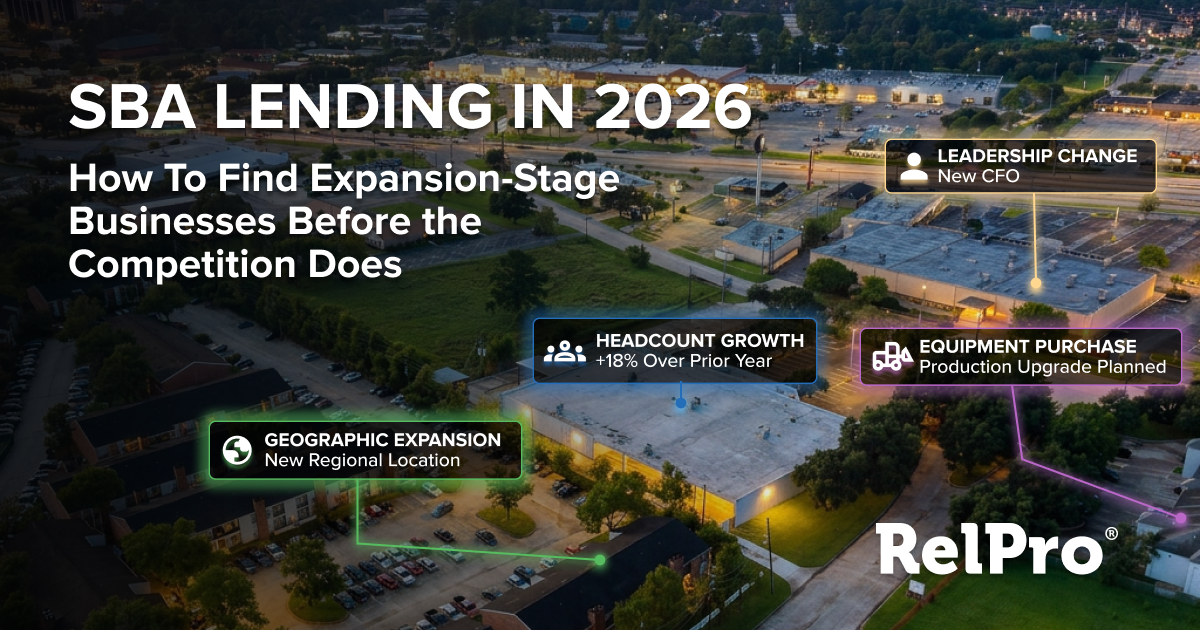
Proactive lenders can identify expansion-stage companies to get ahead of corporate announcements and get an edge on their competition. These growth indicators include:
- Land Purchases/Commercial Real Estate Activity: usually the earliest signs that a company has committed capital to expansion.
- Leadership Changes: new CFOs and COOs often arrive with a mandate to greenlight deferred capital projects.
- Hiring Growth: spikes in hiring roles like plant managers, project engineers, or operations directors often precede the facility buildout by months.
- M&A Activity: acquisitions frequently come with integration capital needs like consolidating facilities, upgrading equipment, expanding capacity to support combining entities, and creating financing demands.
The institutions solving this problem are building workflows that surface signals automatically through leadership changes, hiring spikes, and M&A activity, before they hit the press. With RelPro, lenders can find these companies with buyer intent signals and a workflow for alerts and company updates. These triggers, combined with company and executive intelligence, deliver visibility into corporate expansion plans, executive leadership, operational stakeholders, ownership structures, and the broader network of companies connected to a project.
As investment activity accelerates across manufacturing, infrastructure, energy, and technology sectors, the ability to identify emerging opportunities has become as important as the financing solutions themselves.
Turning Investment Intelligence into Commercial Opportunity
The next several years are likely to be defined by significant capital deployment across the U.S. economy. Manufacturing expansion, AI infrastructure development, energy investment, and supply chain modernization all point toward sustained demand for capital.
For commercial bankers and equipment finance professionals, understanding where CapEx is occurring is only the first step. Success increasingly depends on identifying the organizations behind those investments, understanding the ecosystem surrounding each project, and engaging decision-makers early in the investment cycle.
The advantage goes to institutions that act before the RFP goes out. That means knowing which companies are in early planning stages, who owns the capital allocation decision, and what the surrounding supplier ecosystem looks like. By the time a project is publicly announced, the lead financing relationships are often already forming.
The next investment cycle won't wait. The manufacturers, data center developers, and infrastructure operators committing capital right now are having financing conversations today. The banks in those conversations will win the relationships. The ones waiting for press releases will be calling too late.




Related Blogs & Webinars
View All